Football statistics help explain why a team may be performing better or worse than its recent results suggest. A side can win a match without creating many clear chances, while another can lose despite dominating possession and producing several dangerous attempts.
This is why match analysis should look beyond the final score. Statistics such as expected goals (xG), team form, attacking performance and bookmaker odds provide additional information for assessing football fixtures.
At BettingVoice, we use statistical analysis and match information to help readers understand how teams perform and what the available data may suggest. However, statistics cannot predict every event or guarantee a particular result.
Key Takeaways
- Match statistics reveal more than final scores: They help explain how well teams create chances and defend.
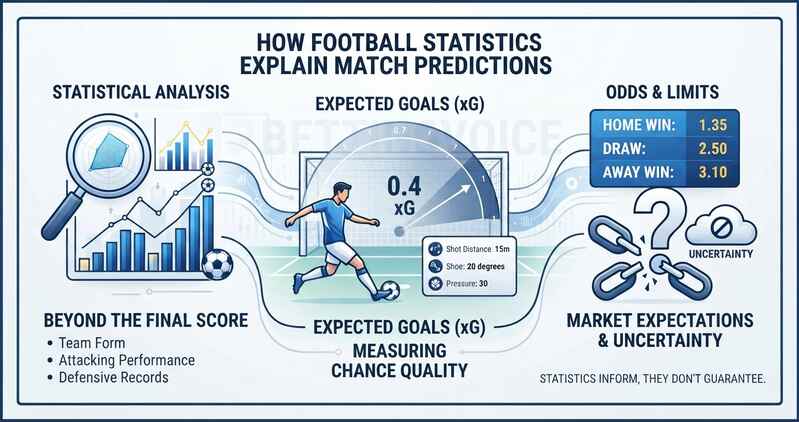
- Expected goals (xG) measures chance quality: It estimates the likelihood that a shot will result in a goal.
- Bookmaker odds reflect market expectations: They provide a useful comparison when assessing a match prediction.
- Context affects statistical performance: Home advantage, opponent strength, injuries and recent form all matter.
- No prediction model guarantees a result: Football matches contain uncertainty, even when the available statistics favour one team.
Why Football Results Can Be Misleading
A football score does not always tell the full story of a match.
For example, Team A might win 1–0 after creating only one clear opportunity, while Team B loses despite producing several dangerous attacks. Looking only at the result could make Team A appear stronger, even though Team B may have performed better in important attacking areas.
Unexpected events can also influence results. Red cards, penalties, defensive mistakes, injuries and missed chances can change the direction of a game.
For this reason, football prediction analysis should consider how teams perform, not just whether they win, draw or lose.
The Role of Expected Goals (xG) in Football Predictions
Expected goals, commonly called xG, is a statistical measure used to estimate the quality of goal-scoring chances.
Each shot receives a value between 0 and 1 based on factors such as:
- Distance from the goal.
- Shooting angle.
- Type of assist or pass.
- Whether the opportunity came from open play or a set piece.
- Defensive pressure and other available shot information.
For example, a penalty usually has a higher xG value than a long-range attempt because it generally offers a better scoring opportunity.
If a team records 2.0 xG in a match, it means the chances it created were worth approximately two expected goals according to the model used. It does not mean the team was certain to score twice.
Why xG Matters
Expected goals can help analysts identify differences between actual results and attacking performance.
A team that regularly creates high-quality chances but scores fewer goals than expected may be experiencing poor finishing or an unusually low-scoring period. A team scoring frequently from relatively low-quality chances may find it difficult to maintain that level.
However, xG should not be considered in isolation. It is more useful when combined with defensive statistics, team form, opponent strength and other match information.
What Bookmaker Odds Tell Us
Bookmaker odds provide another useful reference when analysing football matches.
Odds represent the market’s assessment of possible outcomes, although they also include the bookmaker’s margin. They can reflect information about team strength, recent performances, injuries, public betting activity and other factors.
For example, decimal odds of 2.00 imply a raw probability of 50% before accounting for the bookmaker’s margin.
Comparing a statistical assessment with the odds can help identify differences between an analyst’s estimated probability and the market’s expectation.
However, a difference does not automatically mean a betting opportunity exists. The analysis may be incomplete, or the market may already account for information that the model has missed.
Why Match Context Matters
Statistics become more useful when they are interpreted alongside the circumstances of a fixture. The following factors can influence how reliable a team’s numbers are.
1. Sample Size
A team’s performance across two or three matches may not represent its overall ability. A longer run of fixtures can provide a clearer picture, although there is no single sample size that guarantees reliable conclusions.
2. Home and Away Performance
Some teams perform considerably better at home than away. Analysts should examine their results, goals scored, goals conceded and chance creation in both situations.
3. Opponent Strength
A team may produce impressive attacking statistics against weaker opponents but struggle against stronger defensive sides. The quality of previous opposition should therefore be considered.
4. Injuries and Suspensions
The absence of an important striker, goalkeeper or defender can affect a team’s performance. Recent statistics may become less relevant when the available squad changes significantly.
5. Match Situation
A team protecting a lead may reduce its attacking activity, while a side chasing a goal may take greater risks. These situations can influence possession, shots and expected goals.
The Limits of Football Prediction Models
Statistical models can improve the way football matches are analysed, but they cannot account for every event.
Different models may produce different probability estimates because they use different data, assumptions and methods. Some focus on expected goals, while others consider team ratings, historical results, scoring patterns and additional variables.
Even when several indicators support the same prediction, the outcome can still be different.
A strong statistical assessment might suggest that one team has a better chance of winning, but that does not make the result certain. A red card, unexpected tactical change or individual mistake can alter the match.
At BettingVoice, we believe statistics should be used to understand probabilities and compare possible outcomes—not to promise winning selections.
Frequently Asked Questions
Can football statistics predict match results?
Football statistics can help estimate the probability of different outcomes, but they cannot determine the final score with certainty. They are useful for assessing team performance and comparing possible match scenarios.
What is expected goals (xG) in football?
Expected goals (xG) measures the quality of scoring chances by assigning each shot a probability of resulting in a goal. It helps analysts understand attacking performance beyond the number of goals scored.
Do bookmakers use statistics to set football odds?
Yes. Bookmakers use statistical models, team information, historical performance and other market information when setting odds. Their prices also reflect a margin and can change as new information becomes available.
How many matches should I analyse when studying team statistics?
There is no fixed number that works for every team or competition. Analysing a longer period can provide a broader picture, but recent form, opponent strength and changes in the squad should also be considered.
Can football prediction models guarantee betting profit?
No. Statistical models cannot guarantee profit or eliminate the uncertainty of football. Their estimates can be inaccurate, and even well-supported predictions can fail.
Final Thoughts
Football statistics provide a better understanding of team performance when they are used correctly. Expected goals, attacking and defensive records, home and away form, bookmaker odds and squad information can all contribute to a more informed match assessment.
BettingVoice uses statistical information and football analysis to help readers evaluate fixtures across different competitions and markets. The aim is to explain the available evidence rather than present predictions as certain outcomes.
Responsible gambling: Football predictions are for informational and educational purposes only. BettingVoice does not accept bets or guarantee results. If you choose to bet, use licensed operators and only stake money you can afford to lose. Content is intended for adults aged 18 and over, or the applicable legal gambling age in your location.