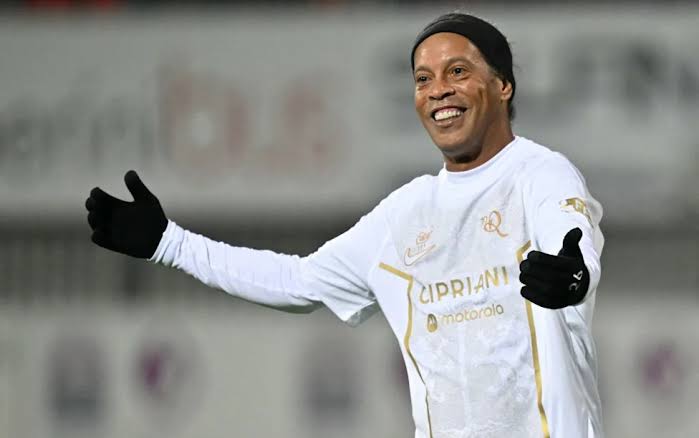
Ronaldinho has returned to competitive football at the age of 46, making an emotional comeback for Italian Serie C side Ravenna after 11 years away from the professional game. But can one of football’s most gifted playmakers still influence a competitive match? His appearance against Forlì on 15 November 2026 offered an intriguing first answer.
The former Barcelona and Brazil star started Ravenna’s derby against Forlì, wore his familiar number 10 shirt and played the entire first half. Although he did not score, he contributed to the move that produced Ravenna’s opening goal in a 2–0 victory.
For football fans following major stories, player developments and match analysis, BettingVoice.com provides football insights and coverage of developments across the game.
Ronaldinho’s Return to Football: What Happened Against Forlì?
Ronaldinho’s comeback became a reality on Sunday, 15 November 2026, when Ravenna hosted local rivals Forlì in a Serie C fixture at the Stadio Bruno Benelli.
The 46-year-old Brazilian was named in the starting line-up, ending an 11-year absence from competitive football. He wore the number 10 shirt, the number associated with some of the most memorable moments of his career.
There had been uncertainty about how much playing time he would receive. Some expectations suggested he might feature for approximately 30 minutes, but he remained on the pitch throughout the first half before being replaced at the interval.
Ravenna eventually won 2–0.
Giulio Donati scored the opening goal in the 36th minute, with Simone Rabbi adding the second in the 58th minute. Ronaldinho was involved in the build-up to Donati’s goal, playing a pass to Lonardi, who helped advance the move before Donati finished from outside the penalty area.
Ronaldinho’s reported match statistics
Football Italia reported the following figures from his appearance against Forlì:
| Match statistic | Ronaldinho |
| Minutes played | 45 |
| Touches | 28 |
| Key passes | 1 |
| Passing accuracy | 81% |
| Goals | 0 |
| Result | Ravenna 2–0 Forlì |
These numbers need to be interpreted carefully. They describe one half of football, not a complete season or a reliable measure of his ability to perform over 90 minutes.
The 81% passing accuracy suggests that he was able to retain possession reasonably well during his appearance. His one key pass also indicates that he produced at least one pass that created a shooting opportunity.
However, his 28 touches show that he was not constantly involved in Ravenna’s possession. The available statistics do not establish that he can sustain the movement, pressing and physical demands expected from a regular Serie C player.
Why Has Ronaldinho Returned to Football?
Ronaldinho’s decision to return is unusual because he had already enjoyed a career that included the World Cup, the Champions League, domestic league titles and the Ballon d’Or.
At 46, he has little left to prove in terms of his historical achievements. His return appears to be driven by a combination of personal relationships, his connection to the game and his involvement with Ravenna.
1. His friendship with Ravenna president Ignazio Cipriani
One of the main reasons behind the move is his relationship with Ravenna president Ignazio Cipriani.
Cipriani announced Ronaldinho’s signing in June 2026. Their relationship helped make the unusual agreement possible, with the Brazilian also acquiring a stake in the club.
This means his connection with Ravenna goes beyond the normal relationship between a footballer and an employer.
He is connected to the club as a player, shareholder and internationally recognised football personality.
2. A desire to experience competitive football again
Ronaldinho has repeatedly spoken about his enjoyment of football.
During his presentation in Italy, he explained that he had come to help his teammates and expressed happiness about returning to the country.
His comments suggested that the opportunity was not solely about personal recognition. He wanted to be part of a football environment again.
After his appearance against Forlì, he described the experience as enjoyable and said that the first half had passed quickly.
He also left open the possibility of playing again, explaining that he would return if the club president called on him.
3. The ambition to score his 300th career goal
Another talking point surrounding Ronaldinho’s comeback has been the possibility of scoring a reported 300th career goal.
Before his return, reports described 299 as his previous career goal total. Reaching 300 would provide a memorable ending to a career that produced some extraordinary moments.
However, career goal totals can vary depending on whether a record includes official senior matches, representative games and other competitions. The 300-goal figure should therefore be treated as a reported milestone rather than a universally agreed statistical total.
Ronaldinho did not score against Forlì, meaning the milestone remains unachieved in his Ravenna appearance.
4. Helping Ravenna build its football profile
Ravenna are not one of the most internationally recognised clubs in Italian football.
The arrival of a former Ballon d’Or winner naturally changes the amount of attention the club receives. His presence has brought international media coverage, increased interest from supporters and a major talking point around the team’s matches.
Ravenna are also pursuing promotion ambitions, making the wider project important.
Ronaldinho’s experience at elite clubs could provide inspiration and visibility, even if his playing contribution remains limited.
His involvement may therefore be valuable beyond what he can produce during 45 or 90 minutes on the pitch.
Who Is Ronaldinho? A Look at His Football Career
Ronaldinho, whose full name is Ronaldo de Assis Moreira, was born on 21 March 1980 in Porto Alegre, Brazil.
He became famous for his exceptional ball control, close dribbling, creativity, vision and ability to produce unexpected solutions in attacking areas.
Although primarily an attacking midfielder, he was also effective on the left wing.
His style of football combined technical ability with improvisation. He could beat defenders in one-on-one situations, create chances through disguised passes and score from difficult positions.
His career took him through several major football clubs, including Grêmio, Paris Saint-Germain, Barcelona, AC Milan, Flamengo, Atlético Mineiro, Querétaro and Fluminense.
Grêmio: Where his professional career began
Ronaldinho developed through the youth system at Grêmio before establishing himself in the senior team in the late 1990s.
His performances in Brazil attracted attention because of his exceptional technical ability and attacking creativity.
He became one of the country’s most exciting young players and earned opportunities with the Brazilian national team.
Grêmio provided the foundation for his move to European football.
Paris Saint-Germain: His first major European challenge
In 2001, Ronaldinho joined Paris Saint-Germain in France.
The move introduced him to European football and gave him an opportunity to develop against some of the continent’s strongest teams.
His time in Paris included moments of individual brilliance, although his relationship with the club and its management was not always straightforward.
Despite the challenges, his performances attracted the attention of Barcelona, who signed him in 2003.
Barcelona: The period that defined his legacy
Barcelona became the most important chapter of Ronaldinho’s club career.
When he arrived in 2003, the Spanish club was searching for a way to return to the top of European football.
Ronaldinho quickly became the centre of the team’s attacking identity.
His ability to carry the ball, create chances and entertain supporters made him one of the most recognisable footballers in the world.
During his time at Barcelona, he won:
- Two La Liga titles.
- One UEFA Champions League title.
- The 2005 Ballon d’Or.
- The FIFA World Player of the Year award in 2004 and 2005.
Barcelona’s official player records describe him as a major figure in the club’s resurgence during the early 2000s.
One of the most memorable moments of his Barcelona career came in November 2005, when he received a standing ovation from Real Madrid supporters at the Santiago Bernabéu after an outstanding performance in a 3–0 victory.
His time at Barcelona helped establish him as one of the greatest entertainers in modern football.
AC Milan: A new chapter in Italian football
Ronaldinho moved to AC Milan in 2008, returning to Italy for the first time since his Ravenna comeback.
Milan signed him from Barcelona, hoping that his creativity would strengthen their attacking options.
He won the Serie A title with the club during the 2010–11 season.
Although he did not consistently reproduce the extraordinary level he had reached at Barcelona, he remained capable of producing decisive passes, goals and moments of individual quality.
His experience at Milan is also relevant to his Ravenna return because he already understands Italian football and its tactical demands.
Flamengo: Returning to Brazil
In 2011, Ronaldinho joined Flamengo.
His arrival generated considerable excitement among Brazilian supporters, and he helped the club win the Campeonato Carioca in 2011.
He scored important goals and remained an influential attacking player, although his time at the club eventually ended amid disagreements and contractual issues.
Atlético Mineiro: A major late-career achievement
Ronaldinho joined Atlético Mineiro in 2012.
This period produced another important achievement when the club won the 2013 Copa Libertadores, South America’s leading club competition.
He was an influential figure in the team’s attacking play and helped Atlético Mineiro reach the highest level of continental football.
His performances also demonstrated that he could remain competitive after leaving Europe’s elite leagues.
Querétaro and Fluminense: The final stages of his playing career
Ronaldinho moved to Mexican club Querétaro in 2014.
He made an impact in Liga MX, contributing goals and technical quality before returning to Brazil to join Fluminense in 2015.
His spell at Fluminense was short. He made his final competitive appearance for the club in September 2015 before leaving professional football.
He officially announced his retirement in 2018.
His return with Ravenna in 2026 therefore represents a comeback after a much longer absence than a normal period between clubs.
Ronaldinho’s Career at a Glance
| Club | Period | Career significance |
| Grêmio | 1998–2001 | Established himself in senior football |
| Paris Saint-Germain | 2001–2003 | Began his European career |
| Barcelona | 2003–2008 | Won the Champions League and two La Liga titles |
| AC Milan | 2008–2011 | Won the Serie A title |
| Flamengo | 2011–2012 | Returned to Brazilian football |
| Atlético Mineiro | 2012–2014 | Won the 2013 Copa Libertadores |
| Querétaro | 2014–2015 | Played in Mexico |
| Fluminense | 2015 | Made his final competitive appearance before retirement |
| Ravenna | 2026– | Returned to competitive football |
For Brazil, Ronaldinho made 97 senior international appearances and scored 33 goals, according to widely reported career records.
His international achievements include the 2002 FIFA World Cup, the 1999 Copa América and the 2005 FIFA Confederations Cup.
Can Ronaldinho Still Perform at 46?
The honest answer is that he can still produce moments of technical quality, but there is not enough evidence to suggest that he can perform consistently at the level required of a regular Serie C starter.
His first appearance for Ravenna provided some useful evidence.
He showed that his ability to control the ball, deliver a dangerous set-piece and make an intelligent pass has not completely disappeared.
However, modern competitive football requires much more than technical skill.
Players must maintain high levels of movement, react quickly to transitions, press opponents, recover possession and repeat demanding actions throughout a match.
These are areas where age and a long absence from competitive football could present significant challenges.
What Ronaldinho can still offer Ravenna
- Technical quality
Ronaldinho’s close control and passing ability were central to his success throughout his career.
These qualities are not necessarily lost simply because a player gets older.
His involvement in Ravenna’s opening goal against Forlì demonstrated that he could still contribute through a technically sound action.
- Creativity in the final third
Ravenna may benefit from his ability to recognise passing opportunities and deliver the ball into dangerous areas.
An experienced attacking midfielder does not always need to cover the same distance as a younger player to influence a game.
However, this depends on the team creating the right conditions around him.
- Set-piece delivery
Ronaldinho was known for his free-kicks, corners and ability to create chances from dead-ball situations.
His corner against Forlì produced a headed opportunity for Donati, showing that this aspect of his game can still be useful.
- Experience and influence
He has played in the World Cup, Champions League, La Liga, Serie A and Copa Libertadores.
That experience gives him a perspective that few players in Serie C can match.
His presence could also motivate younger teammates and increase their confidence.
What Could Limit His Performance in Serie C?
Despite his technical ability, Ronaldinho faces several practical challenges.
Match fitness
His last competitive appearance before Ravenna came in 2015.
That is an exceptionally long period without regular professional football.
Playing 45 minutes is encouraging, but it does not demonstrate that he can complete a full match or maintain the same level over several weeks.
Physical speed and movement
Serie C is a competitive professional league.
Players must react quickly, cover space and participate in both attacking and defensive transitions.
At 46, Ronaldinho is unlikely to possess the same acceleration and repeated running capacity that helped him dominate defenders during his prime.
There is no publicly verified fitness data from his Ravenna appearance that allows a precise comparison with younger players.
Tactical demands
Modern football places significant emphasis on coordinated pressing and defensive organisation.
A player who contributes creatively must also understand when to close passing lanes, track opponents and support teammates without the ball.
Ravenna may need to adjust their approach if Ronaldinho is to feature regularly.
Consistency
One impressive pass or successful set-piece does not establish that a player can influence every match.
The real test will be whether he can reproduce useful contributions against different opponents and in different match situations.
For that reason, his first appearance should be treated as an interesting starting point rather than proof of a complete competitive comeback.
What Does Ronaldinho’s Return Mean for Ravenna?
Ronaldinho’s arrival has given Ravenna an extraordinary level of international attention.
The club is competing in Serie C, Italy’s third tier, but its connection with a former Ballon d’Or winner has made it a talking point well beyond its local fan base.
Ravenna’s ambitions are also important.
The club is seeking promotion to Serie B, where it last competed in the 2007–08 season.
His presence could support that ambition in several ways:
give the club international recognition, create a connection between his personal reputation and the club’s wider project,and provide a positive influence within the dressing room.
Could Ronaldinho Play More Serie C Matches?
His first appearance has left the possibility open.
After the Forlì match, Ronaldinho indicated that he would return if the club president called him again.
That comment suggests that he enjoyed the experience and has not completely ruled out another appearance.
Final Verdict: Can Ronaldinho Still Perform?
Ronaldinho’s return to competitive football is one of the most unusual football stories of 2026.
At 46, after an 11-year absence from competitive matches, he started for Ravenna against Forlì and completed the first half of a match that ended in a 2–0 victory.
His contribution was not simply ceremonial. He helped create the opening goal, produced a dangerous corner and recorded 28 touches, one key pass and 81% passing accuracy in the first half.
Those figures suggest that he can still contribute technically in selected situations.
However, they do not prove that he can compete regularly across a full Serie C season. Match fitness, speed, tactical responsibilities and consistency remain significant questions.
The most reasonable expectation is that Ronaldinho could provide occasional technical contributions, experience and inspiration if Ravenna decide to use him again.
His comeback should not be judged by whether he can recreate the player who won the 2005 Ballon d’Or. That version of Ronaldinho belongs to football history.
For now, his appearance against Forlì has provided a memorable answer: the magic of his technique is still recognisable, even if the physical demands of professional football are a different challenge at 46.
For more football news, match developments, player analysis and statistical insights, follow BettingVoice, a platform focused on helping football fans understand what is happening across the game.
Frequently Asked Questions
How old is Ronaldinho in 2026?
Ronaldinho was born on 21 March 1980. He is 46 years old as of November 2026.
Which club did Ronaldinho join for his football comeback?
He returned to competitive football with Ravenna, an Italian club competing in Serie C, the third tier of Italian football.
When did Ronaldinho last play professional football before his comeback?
His final competitive appearance before the Ravenna return was for Fluminense in September 2015. He officially announced his retirement in 2018.
Did Ronaldinho play against Forlì?
Yes. He started for Ravenna against Forlì on 15 November 2026 and played the entire first half before being substituted at half-time.
Did Ronaldinho score on his Ravenna debut?
No. He did not score, but he contributed to the attacking move that led to Giulio Donati’s opening goal in Ravenna’s 2–0 victory.
How many minutes did Ronaldinho play against Forlì?
He played 45 minutes, completing the first half of the match.
Why did Ronaldinho return to football?
His return was connected to his friendship with Ravenna president Ignazio Cipriani, his involvement as a club shareholder, his desire to help the team and his continuing enjoyment of football. He also expressed interest in reaching a reported 300th career goal.
Can Ronaldinho still play at a professional level?
His first-half appearance showed that he can still contribute technically. However, there is not enough evidence yet to establish that he can perform consistently or play full matches in Serie C.
Has Ronaldinho won the Ballon d’Or?
Yes. He won the 2005 Ballon d’Or after an outstanding period with Barcelona and Brazil.
What major trophies did Ronaldinho win?
His major honours include the 2002 FIFA World Cup with Brazil, the 2005 Ballon d’Or, the 2005–06 UEFA Champions League with Barcelona, two La Liga titles and the 2013 Copa Libertadores with Atlético Mineiro.