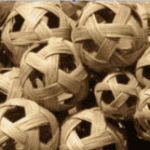
To Chinlone, the attribute of endurance is more valuable than brute force. An almost no-touch ball by the rattan is a common sight in a properly conducted session, and the players, except for their hands, use different parts of their bodies, namely the feet, knees, shins, and the backs of their heels, to keep it suspended in the air.
The intricacies of the game have been perfected by players from different eras, who turned the essential skill of ball control into a combination of sport and art. Sports fans who prefer to follow Southeast Asian traditional sports along with lifestyle and gambling through market apps like the Melbet app will surely feel the uniqueness of Chinlone, given that sportsmanship and team play are the energies driving both competing for perfection and avoiding direct confrontation.
At first glance, the rules of ball control in chinlone appear very easy and undemanding. Players work in teams while passing the ball. A group of six players takes turns throwing the ball to one another to a central player who performs solo tricks and combinations. The center player is the performer. The circle players are the supporters.
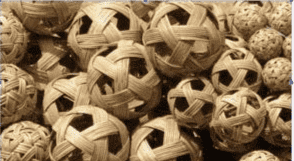
The Six Fundamental Kicks
The technical framework of Chinlone is built on the foundation of six basic kicks, which must be learned by each player as a prerequisite before attempting any advanced combinations. Each kick uses a different part of the foot or leg, and the ability to perform all six is regarded as the least necessary for a player to compete in a circle. The six kicks are arranged in the following way: from natural to counterintuitive contact points:
- inside kick (using the flat inner surface of the foot near the arch);
- outside kick (striking with the outer edge of the foot);
- back kick (contacting the ball with the sole while the foot swings backward);
- knee kick (lifting the ball with the top of the knee or lower thigh);
- shin kick (using the front surface of the lower leg);
- heel kick (catching or redirecting the ball with the back of the heel).
Each kick must produce a clean, controlled contact that sends the ball to a predictable height and direction.
Advanced Tricks and Combinations
Once a player controls all six basic kicks consistently, the vocabulary of chinlone opens up. Advanced techniques involve behind-the-back contacts, mid-air catches with the sole, rapid alternation between contact points, and what Burmese players call “flying kicks” – acrobatic movements where the player leaves the ground to make contact.
The advanced techniques considered the most esteemed in the field encompass:
- cross-body contacts, wherein the right foot reaches behind the left leg to kick the ball;
- sole stalls, wherein the ball briefly rests on the bottom of the foot before being flicked up;
- and spinning contacts, wherein the player turns 180 or 360 degrees between touches.
Sports enthusiasts who are in the hunt to get insight into Myanmar’s traditional sports culture by using Melbet casino and similar platforms can catch the championship chinlone performances, where these combinations are executed in rapid succession.
Training Methods and Physical Demands
Chinlone learning is done in a gradual and orderly manner. Fresh recruits spend weeks mastering their ball before they join the group. Individual training consists of keeping the ball in the air as long as possible with one kick type only, and then moving on to another. The main aim is to teach your body to remember the right contact points so that the movement can be done without thinking about it.
The flexibility of joints is more important to chinlone players than strength. Players should be able to do the behind-the-body kicks and low-to-ground recoveries by using the full range of motion in the hips, ankles, and knees. Stretching is a daily routine for competitive players, with a focus on hip flexors and ankle mobility in particular.
In addition, balance training is essential. Several advanced techniques require the player to stand on one foot while the other leg makes a special kick. Standing on unstable surfaces and rehearsing single-leg squats are some of the strategies to develop the required stability for these actions.
Chinlone in Competitive Context
Chinlone competitions in Myanmar are the official events that are held every year, and they attract thousands of viewers, especially during the seasonal period of the Waso Festival. Teams are assessed based on their technical skills, artistic expression, integration of circle players with the center performer, and overall response from the audience. There are no rivals in the usual sense, as the seams perform independently and receive separate scores.
The lack of actual rivalry does not diminish the pressure. Players prepare throughout the year for training. Regional teams face off to gain national acclaim. The most outstanding players become the stars within Myanmar’s athletic scene. The performance quality at the very peak of this level mirrors elite gymnastics or figure skating in terms of accuracy and complexity.