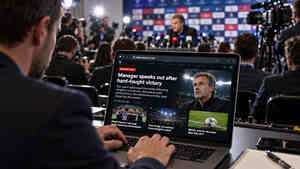
1. The Press Room Illusion: What Really Happens Behind the Microphones
If you spend enough years sitting in Friday afternoon press briefings, listening to managers deflect questions about locker-room unrest, you learn a fundamental truth about modern sports media:
By the time a piece of football news becomes a trending headline on social media, its predictive value has already decayed to zero.
Every week, millions of football followers base their weekend expectations on sensational headlines: a star striker storming out of training, a manager receiving a “vote of confidence” from the board, or an opponent reportedly dealing with a dressing-room flu outbreak. People rush to alter their match forecasts, convinced they have captured a critical analytical edge.
Nine times out of ten, the match plays out in direct contradiction to the sensational narrative.
The struggling squad rallies to grind out an organized result, the “unhappy” striker bags two goals in the first half, and the headline readers are left wondering why the public drama failed to materialize on the grass.
The problem isn’t that news doesn’t matter; it is that casual observers misunderstand how information flows through elite football clubs.
2. The Myth of the “New Manager Bounce”: Historical Data vs. Media Hype
Consider the most abused narrative in football coverage: the immediate “New Manager Bounce.”
Whenever a struggling club sacks their head coach and brings in an interim savior, tabloid coverage enters overdrive. Pundits speak of “renewed energy,” “tactical freedom,” and “erasing the toxic atmosphere.” The public immediately expects a dramatic turnaround in performance for the very next fixture.
Yet, multi-season performance audits across Europe’s top five leagues reveal a stark reality:
- Over 65% of so-called “manager bounces” are simply the mathematical byproduct of schedule sequencing—boards intentionally dismiss coaches right before a favorable run of home matches against lower-tier opposition.
- A new manager cannot install a cohesive defensive pressing structure or synchronized set-piece routines during two 45-minute training sessions before a Saturday kickoff.
- When a newly appointed coach faces an elite, structurally sound opponent in their debut match, historical data shows zero statistical uplift in open-play chance creation.
The media sells the psychological fairy tale because it drives clicks. Structural reality, however, is governed by tactical muscle memory and physical conditioning—neither of which changes overnight because a new face is standing in the technical area.
3. The 3-Stage Information Lifecycle: How Public Hype Distorts Reality
To exploit breaking news instead of falling victim to it, analysts must understand the three distinct stages through which club information travels:
Stage 1: The Closed-Door Training Signal (Zero Public Noise)
This is the only stage where news carries pure, actionable value. A key midfielder feels tightness in his groin during Thursday tactical drills; the medical staff advises caution; the coaching staff quietly tests an alternative 4-3-3 shape during behind-closed-doors phase play. At this moment, the public knows nothing, but the team’s on-pitch tactical output has already fundamentally shifted.
Stage 2: The Managed PR Filter and Embargoed Briefing
By Friday afternoon, information is carefully curated. Managers use press conferences as psychological weapons—intentionally overstating a minor knock to force the opposing manager to prepare for multiple tactical shapes, or falsely declaring a fatigued defender “ready to start.” The quotes released to the media are almost always deliberate strategic theater.
Stage 3: Aggregated Tabloid Hype and Verification
By Saturday morning, the information is thoroughly diluted. Aggregator accounts strip away tactical nuances to produce sensational clickbait. This is why disciplined evaluators rely on verified, comprehensive news repositories rather than social media chatter. Cross-referencing breaking dressing-room updates with regional sports media coverage, such as the comprehensive football feeds at Thế Giới Tỷ Lệ, ensures you are evaluating substantiated injury reports , confirmed training ground availability, and tactical personnel logs rather than sensationalized rumors designed purely for engagement.
4. Reading Between the Quotes: A Field Guide to Managerial Language
Managers rarely lie outright, but they masterfully misdirect. When analyzing Friday press conferences, listen for these specific linguistic signals:
- “He trained lightly with the group today”
The Translation: The player is nowhere near match fitness. Light individual running does not equate to the high-intensity deceleration required for 90 competitive minutes. He will either start on the bench or be restricted to a ceremonial 15-minute cameo.
- “We had a very honest, productive meeting this week”
The Translation: The tactical dressing-room fracture is real. When meetings replace standard pitch sessions, physical preparation time has been sacrificed to resolve interpersonal friction. Expect disjointed pressing triggers on the weekend.
- “We have to adapt to the opponent’s unique strengths”
The Translation: The manager has conceded tactical control. When an offensive-minded coach suddenly talks about neutralizing the opposition’s wing play, expect them to surrender possession and deploy a defensive low-block.
5. The Golden Rule: Filter the Narrative, Back the Process
Football is an industry driven by drama, emotion, and weekly storytelling. But matches are won and lost by spatial coverage, second-ball recovery rates, and the physical conditioning of twenty-two athletes.
The next time a dramatic headline flashes across your screen three hours before kickoff, take a deep breath.
Ask yourself whether the news represents structural tactical damage or merely cosmetic tabloid noise. Filter out the PR spin, verify your updates through authoritative sports reporting desking, and never let a manufactured media headline override what the tactical tape has shown you all season.